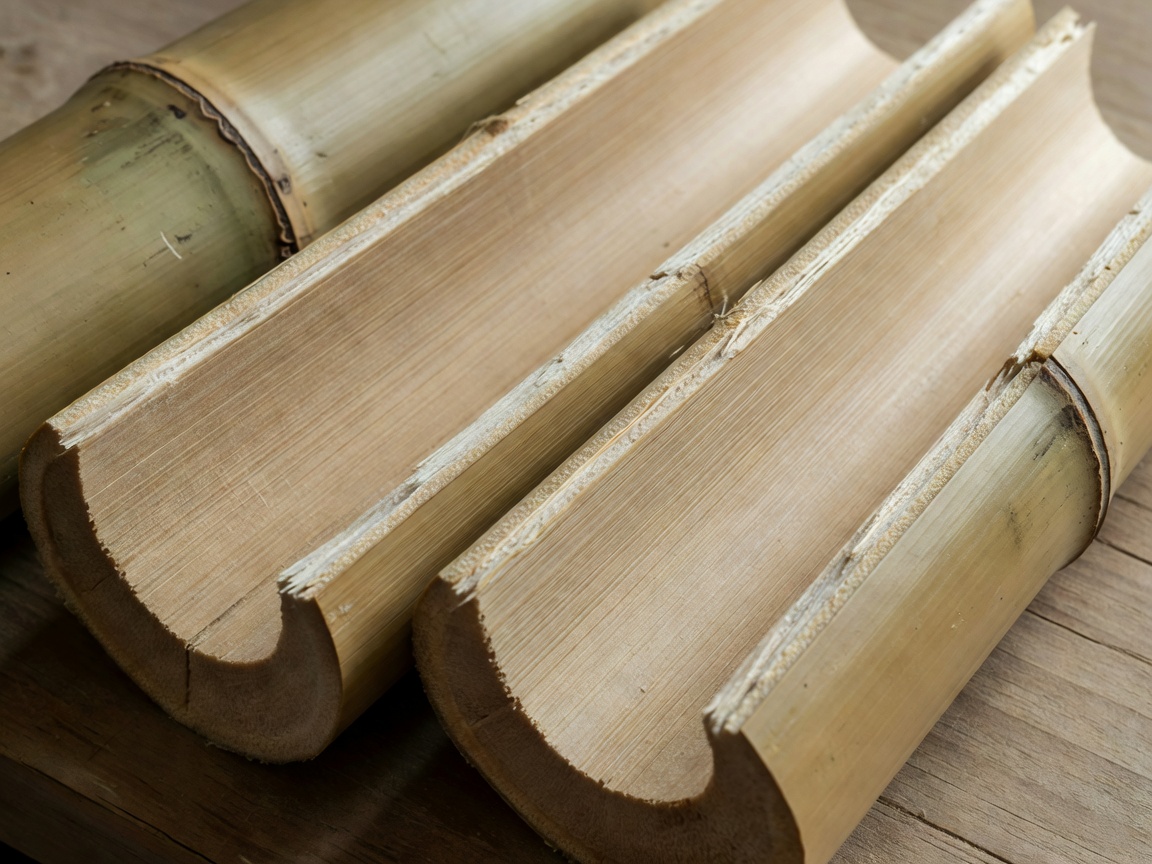
The culm is a starting condition
A bamboo culm is the upright stem of the plant. It is usually hollow between nodes, with a wall whose thickness and internal structure vary. For a craftsperson, diameter, straightness, node spacing and visible defects all affect what can be taken from it. A large culm is not automatically the best choice, because the intended strip may require a particular balance of flexibility, surface character and strength.
Japanese craft descriptions frequently mention madake, commonly identified as Phyllostachys bambusoides. Mōsōchiku, often identified as Phyllostachys edulis, and hachiku also appear in discussions of bamboo materials. These names help establish context, but species alone does not predict the quality of an object. Growing conditions, maturity, treatment and the maker's selection remain important. Avoid treating every green stem or pale finished strip as botanically identifiable from a photograph.
Conditioning changes the working material
Freshly cut bamboo contains moisture and substances that can complicate storage and use. Depending on the material and workshop practice, preparation may involve drying, heat treatment or processes intended to remove oils and surface residues. Pale bamboo sometimes described as shiratake is associated with such preparation, rather than simply being a naturally white plant. Terminology and sequences vary, so a single workshop account should not be expanded into a universal recipe.
Drying is a practical concern, not a guarantee that the material will never move again. Bamboo continues to respond to its surroundings. Poor storage can encourage mold or insect problems, while uneven conditioning can make later work less predictable. This is why a finished object should be understood as the result of several related decisions, not just a clever weave applied to whatever material happens to be available.
Splitting follows, but also controls, the fiber
Splitting divides a culm lengthwise into narrower pieces. The long grain encourages the separation, but it does not make the process self-correcting. A split can drift, a node can interrupt the working surface, and an apparently generous section can yield less usable material than expected. Experienced preparation manages the direction and proportions of the division rather than relying on force alone.
Repeated division produces pieces closer to the required width. Thickness must also be considered: a broad strip may need to be thin enough to bend around a tight curve, while a supporting element may need greater substance. The dense outer portion of the wall can be valuable, but its suitability depends on the object. There is no general rule that every visible outer surface must remain on every component.
- Width sets the visual rhythm
Small differences can accumulate across a closely repeated pattern.
- Thickness shapes the bend
A strip's ability to turn is not determined by width alone.
- Edges affect contact
Careful finishing matters where strips cross and where hands meet the object.
Sizing is part of the design
After rough division, strips can be refined to more consistent dimensions. This work is easy to overlook because its success often appears as quiet regularity. When strips sit cleanly beside one another, the viewer may notice only the pattern. Yet uneven thickness can alter tension, and an abrupt edge can create an unwanted stress point. Preparation is therefore not merely a preliminary task delegated to the material; it is one of the ways a maker determines the final form.
Some objects deliberately combine strips of different sizes. A rim, handle or structural rib has a different job from a fine weaving strand. Uniformity is useful within a role, but uniform dimensions across the entire object are not a measure of excellence. Look instead for a convincing relationship between the component and the work it performs.
Observe safely, without turning this into a recipe
Split bamboo edges can be sharp, and specialized knives and heat treatments introduce additional risks. This guide explains material choices; it is not a cutting, heating or chemical-treatment tutorial. If you want practical experience, seek instruction that covers tool handling, material inspection and a suitable workspace. For looking at a finished object, a safer beginning is to trace the changes in strip width, note where nodes remain visible and compare the sturdy rim with the more flexible body.
Further reading and source notes
Use collection records to check material descriptions and regional craft resources to understand terminology. These resources are starting points, not evidence that every process described here was used for a particular object.
- Association for the Promotion of Traditional Craft Industries — regional craft profiles.
- The Metropolitan Museum of Art — search the collection for Japanese bamboo baskets and their materials.
- The British Museum — collection records for comparative object study.