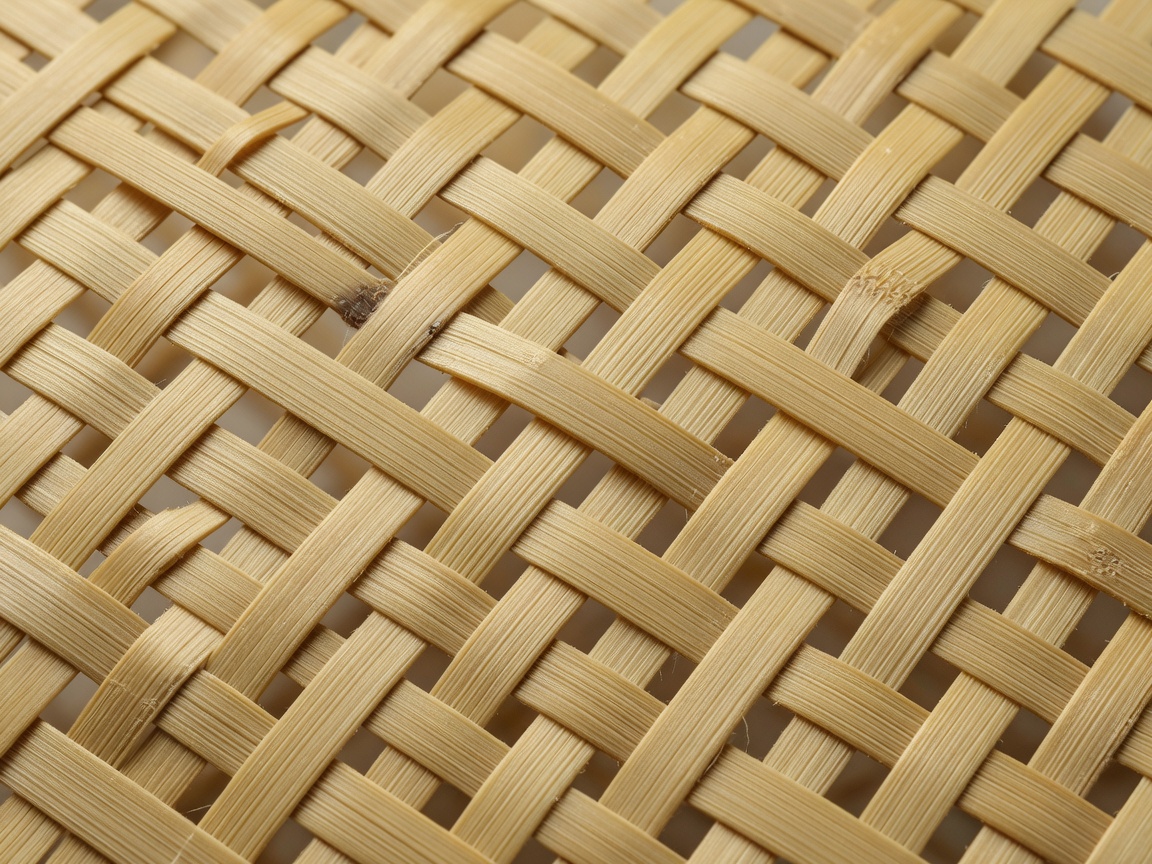
A pattern is not a complete explanation
Recognizing a pattern gives you an entry point into a bamboo object, but it does not tell you everything about its construction. Two baskets can share a visible over-and-under arrangement while differing in strip thickness, base design, edge treatment and overall rigidity. A photograph may reveal the surface clearly while concealing the underside, internal reinforcements or the way a handle is attached. Treat the name of a weave as one piece of information, not a complete technical diagnosis.
The working strip also retains the consequences of preparation. Its width affects the scale of the pattern, while thickness influences how readily it bends. A strand that behaves well across a broad base may resist a tight turn at the shoulder. Weaving therefore cannot be separated neatly from material selection. The maker is continually matching the strip's behavior to the shape being developed.
Three useful families of relationships
Simple alternating crossings are often introduced through yotsume-ami, a square or four-eye openwork arrangement. Hexagonal openwork is commonly discussed as mutsume-ami. Twill arrangements, often grouped under ajiro-ami, produce a different rhythm as strips pass over and under more than one neighboring element. English translations and spellings vary, and each broad term can cover variations that deserve closer description.
These names are not exclusive signatures of one town or one artist. Nor does an open pattern automatically mean an easy object. Keeping repeated openings consistent around a changing volume can demand considerable control. Conversely, a dense surface is not automatically stronger in every direction. Performance depends on the whole construction, including material dimensions and how the woven body is supported at its edges.
| Visible feature | Useful question | What it cannot establish alone |
|---|---|---|
| Open square crossings | How are the intervals maintained? | Maker, date or region |
| Hexagonal openings | Where do directions change? | Difficulty or durability |
| Close twill surface | How do strip width and overlap interact? | Suitability for wet food |
| Bound rim | How are cut ends contained? | Safe carrying capacity |
From a plane to a volume
A woven base establishes relationships that must continue, change or terminate as the walls rise. The transition may be gradual or sharply defined. A maker can adjust spacing, introduce structural elements or change the direction of the strips to shape the object. Looking for this transition is often more informative than studying the most decorative section first, because it shows how the object negotiates a genuine construction problem.
Tension matters throughout this process, but “tighter” is not a universal synonym for “better.” Excess force can distort a surface or stress a strip. Insufficient control can leave unwanted movement. The desired balance depends on the weave, the material's condition and the intended form. Small variations may be deliberate, especially where a sculptural object departs from the regularity expected of an everyday container.
The edge is a structural event
A rim brings a woven field to an end. It can contain cut strips, stiffen the opening and create a surface comfortable to handle. Bindings may use bamboo or another material, including rattan, so a bamboo basket need not be made entirely from one plant. Look at collection descriptions or the maker's documentation rather than assuming that every narrow binding is simply a thinner version of the body strip.
A handle introduces another set of forces. Its attachment may distribute a load through several parts of the body, or it may primarily complete a visual composition. Never test an unfamiliar or old basket by filling it and lifting it from the handle. Structural interpretation and safe handling are different tasks; a convincing-looking connection can still contain hidden damage or fragile aged material.
How to practice looking
Choose one visible strip and follow it with your eyes until it disappears or changes direction. Then find the next strip performing the same role. Compare the spacing near the base with the spacing near the rim. Finally, step back and ask how those local decisions support the larger silhouette. This exercise requires no handling, and it works with a well-lit museum image as readily as with a household object.
Do not confuse patience with proof of authorship. Even careful visual study cannot replace provenance, signatures, reliable records or specialist assessment. Its value is different: it gives you a clearer language for asking what a maker has solved, and for appreciating labor that is easy to overlook when the finished surface appears effortless.
Further looking
Compare credited collection photographs at the Metropolitan Museum of Art and the British Museum. Consult the traditional craft directory for regional terminology. A general illustration on this site is not evidence of a named technique.